Beta. The official launch is in early December 2026. Until then, feedback is welcome at hello@sharkuracy.org.
How we rate
Sharkuracy rates how accurately movies, TV, documentaries, games and books portray sharks.
SharkurateSHARK-yuh-rutadjective
Accurately depicts shark appearance, behaviour, ecology, abilities and motivations, by being true to nature.
Not painting them as ruthless killing machines, but also not making them vegan and best friends with humans.
Sharkuracy was founded by Miguel Pessanha Pais, a marine biologist, and Diogo Veríssimo, a conservation marketer. About the team says more.
Why sharks matter sets out what is at stake for real sharks, with sources.
Why accurate media portrayal matters sets out how sharks are shown, how that changes what people feel about them, and how it can reach policy, with sources.
Shark resources lists free places to learn more about sharks and to help them.
One question behind every criterion
Is this part of the picture true to nature?
A portrayal can fail in two directions. Demonising shows sharks as monsters, man-eaters, villains, a menace or a plague. Sanitising (or romanticising) shows them as vegetarians, people's best friends, harmless whatever the situation, or the heroes of an exaggerated story. Both lose points, in the same way.
DemonisingSanitising
True to nature
Mostly true to nature
Mixed
Distorted
Grossly distorted
Distortion in either direction, or both at once, moves a criterion down the same five levels.
Diagram: how the levels work, not measured data.
Five levels, shared by every criterion
Every criterion is judged on the same five levels, from 1, the worst, to 5, the best. Rubrics give more reliable ratings when every level is described for the topic and illustrated with examples [1], so every criterion below says what to look for at each level.
Grossly distorted
The picture is false at its core, in either direction.
Distorted
Clear distortions outweigh what is true.
Mixed
True and distorted elements roughly balance, or the work says too little on this to be called either.
Mostly true to nature
True on the main points. At most minor slips, or dramatic licence that does not create or repeat a myth.
True to nature
Nothing that misleads about real sharks. Teaching or correcting myths is welcome but not required.
The four criteria
Every rating judges these four criteria, in this order, each at one of the five levels.
Scientific Accuracy
Core criterion: always scored
What it judges: whether what the work shows sharks are and can do is true: species and appearance, size, senses, abilities, diet and feeding, and factual claims.
Grossly distorted
The central claims about sharks' bodies or abilities are false: impossible size, senses, powers or behaviour, shown as real or as shark nature in an openly impossible story (sharks that fly through the air to bite, or swim through sand), an extinct species shown alive as a real-world fact, or faked evidence presented as real (a staged special presented as a genuine documentary).
Distorted
Several clear errors or myths, in either direction, with few accurate elements. Exaggerated: a drop of blood sets off a frenzy, a shark roars. Understated or simply wrong: sharks shown as toothless or harmless by nature, able to live without eating animals, or "sharks don't get cancer".
Mixed
Accurate and inaccurate elements roughly balance, or the sharks are so stylised (a cartoon or fable whose only impossibility is the fantasy device, such as talking) that the work says little about real sharks either way.
Mostly true to nature
The species is recognisable and right for the place; body, senses and abilities are realistic. At most minor slips, such as a shark a little large for its species, or one species' trait stated for all sharks ("sharks must keep swimming to breathe" is true of some species, not of nurse sharks).
True to nature
What the work shows or says about sharks' bodies and abilities is true, and its factual claims match current science. Explaining biology or correcting a myth is welcome but not needed.
Why it matters
Films, shows, games and books teach people what sharks are, and stories teach as much as documentaries. Young children who watched a cartoon with humanlike animals carried what they learned about one animal over to other animals more readily than children who watched a documentary [2]. So a myth in a cartoon counts like a myth anywhere else.
The level descriptions name concrete things on purpose. In a study of 32 years of Shark Week, coders agreed closely on concrete things, such as which species was shown, and much less on interpretive ones [3].
Motives & Risk
Core criterion: always scored
What it judges: whether the work shows truly why sharks act and how dangerous they are to people: motive and intent, the real size of the risk, and the framing around it (words, music, titles, posters).
Grossly distorted
Sharks' motives toward people are invented at the core: they hunt people out of human-like malice, revenge or a taste for humans (for example a shark that pursues one family to another ocean).
Distorted
Clear distortion of motive or risk dominates. Demonising: encounters framed as attacks, with ominous music, gore, titles or posters, and no sign that bites are rare or have causes. Sanitising: sharks shown as people's devoted friends, guardians or pets, as friends who give up eating, as safe to grab, ride or hug, or the risk to people denied.
Mixed
Natural and distorted portrayals roughly balance, or sharks are incidental and the work says little about why they act or how risky they are.
Mostly true to nature
Sharks act from natural motives (feeding, curiosity, investigating, defence). Risk to people is real and in proportion, with some dramatic licence (suspense music in one scene, one "attack" headline).
True to nature
Natural motives throughout. Where the work deals with risk to people, risk is shown as it is, real but rare, with its circumstances, and with neither sensational framing nor false reassurance; where risk never comes up (a nature documentary), natural motives are enough. Explaining how rare bites are is welcome but not needed.
Why it matters
In the studies we read, threat dominates in film, news and television. Of 109 films with sharks, 96% portrayed encounters between sharks and people as threatening [4]. Shark attacks were the emphasis of more than half of 300 Australian and US newspaper articles, and conservation the main topic of 11% [5]. In Shark Week, 73.6% of the episodes analysed used fear-mongering language or portrayed sharks negatively [3].
Framing changes how people feel about real sharks. Positively framed videos lowered viewers' fright, how dangerous they thought sharks are and how far they thought bites are intended, and negatively framed videos raised them [6]. Violent images of sharks biting people raised fear even when a conservation message was paired with them [7].
Words count too. The label "shark attack" is misleading, and researchers have proposed naming sightings, encounters, bites and fatal bites instead [8]. That is why this criterion judges the framing as well as the motives.
Ecological Context
Can be Not applicable, in fiction only
What it judges: whether the work shows sharks' place in nature truly: habitat and range, prey and other species, and their role in the ecosystem. What the work shows counts as a claim even when nobody says it: a shark that hunts people as its usual prey is a claim about its prey.
Grossly distorted
The picture of sharks in nature is false at its core: an impossible habitat or range shown as real (a prehistoric species alive in the deep sea), sharks as a plague the ocean would be better without, or people as their usual prey.
Distorted
Habitat, range or prey clearly wrong for the species or place (a great white in a freshwater lake; bull sharks, though, really do enter rivers and lakes), or sharks emptying an area of fish.
Mixed
True and false elements roughly balance, or the work says too little to judge: a believable setting and nothing more. Also the level for an overstated role in an otherwise true picture ("sharks eat only the sick and weak", "without sharks the ocean dies"). In a factual work, also the level for showing no ecological context at all.
Mostly true to nature
Right habitat and range; sharks are seen with real prey or other species. At most minor slips, such as a simplified food chain or a species a little out of its range.
True to nature
Habitat, range, prey and role shown as they are, and any claim about the shark's role is accurate and not overstated (for example grey reef sharks shown hunting groupers at a spawning aggregation). Explaining the ecology is welcome but not needed.
Not applicable: only in fiction with nothing about sharks' real place in nature to judge, such as a shark seen in one scene of an invented world. An impossible premise is not enough when the work still shows what sharks eat or where they live. Never in a factual work.
Why it matters
Sharks' place in nature can be distorted both ways: shown as a plague the sea would be better without, or given a role bigger than the evidence. Most shark species on coral reefs are not apex predators but mid-level predators, alongside many reef fish, and the evidence that sharks benefit corals through a chain of effects on other species is weak [9]. A well-known claim that shark declines set off a boom in cownose rays did not hold up when the data were re-examined: the declines and the supposed boom did not coincide [10].
So this criterion asks for sharks' place in nature as it is, neither erased nor inflated.
Human Impact & Conservation
Can be Not applicable, in fiction only
What it judges: whether the work shows truly what people do to sharks and what it does to them: fishing, finning, bycatch, culls and other harm, the state of shark populations, threats, protection and solutions. What the work shows counts as a claim even when nobody says it: a shark hunt shown as the fix for bites is a claim about human impact.
Grossly distorted
The picture of human impact is false at its core, either way. Killing or harming sharks is shown as harmless, heroic, fun or the fix for bites (celebrated hunts, culls, trophy kills), or sharks are said to need no protection. Or the reverse: the work's case rests on invented or grossly false figures about the threats.
Distorted
Harm to sharks is shown as normal or without consequence, with no comment. Or the threats are clearly misstated: finning presented as the whole problem, when the main threat is overfishing (sharks caught for meat and fins, and as bycatch); doom claims such as "the oceans will be empty by 2048"; or inflated or outdated figures carrying the argument.
Mixed
True and distorted claims roughly balance, or the work says too little to judge: a generic line ("sharks are in trouble") that names no threat. In a factual work, also the level for saying nothing at all about human impact.
Mostly true to nature
The main threats and the state of sharks are shown truly. At most minor slips: a dated or rounded figure, one threat given a little too much weight, a solution slightly oversold.
True to nature
Human impacts, threats and solutions are shown as they are and in proportion. No harm is shown as costless and nothing is exaggerated. Advocacy or a call to action adds nothing; it is judged only on whether its facts are right.
Not applicable: only in fiction that shows no harm to sharks beyond self-defence and says nothing about their numbers or protection. Never in a factual work.
Why it matters
Overfishing drives over a third of all shark and ray species towards extinction, and it is the one threat that affects every threatened species [11]. Media coverage of shark conservation is often inaccurate and skewed towards finning, and many people who care about sharks know of only one threat and few of the solutions [12].
Mentioning conservation is not the same as getting it right. Shark Week mentioned conservation in 53.2% of the episodes analysed, but said anything specific or actionable in 3.0% [3]. So this criterion asks whether the facts about people's impact are right, not how much the work says about conservation.
The rules every rating follows
1.Judge whether the picture is true, not whether it is kind to sharks. A man-eating monster and a vegetarian best-friend shark both lose points.
2.Distortions in opposite directions add up; they do not cancel out. A film with one friendly vegetarian shark and one gangster shark is distorted twice, not balanced. Judge the combined picture: two clear distortions in opposite directions can together bring a criterion down to level 1 when nothing true is left. "Mixed" means true and distorted elements together.
3.Level 5 asks for accuracy, not a lesson. Teaching, correcting myths, advocacy and calls to action earn nothing extra. A call to action is judged only on whether its facts are right. On Motives & Risk, a work where risk to people never comes up (a nature documentary) can still reach level 5 when sharks act from natural motives throughout.
4.Judge the portrayal, not the quality of the work, and judge the whole work. In a minor role, every statement about sharks counts, wherever it appears in the work; general claims not about sharks do not (for example a claim about fish stocks in general).
5.Factual works are judged on every claim; fiction only on what it shows as true of real sharks. Documentaries, non-fiction, mockumentaries and dramatised true stories (for the events they depict) count as factual. A myth shown as fact counts as an error even in fiction (megalodon still alive). Only the fantasy device itself is not an error, such as a cartoon shark that talks or walks; what the work shows as shark nature inside it is judged. Impossible shark abilities or behaviour (sharks that fly through the air to bite, or swim through sand) score level 1 on Scientific Accuracy, even in an openly impossible story.
6.Talking sharks are fine; the motives they are given are judged. Human-like malice and human-like friendship (giving up eating, devotion to people) both misstate why sharks act.
7.Two criteria are always scored (Scientific Accuracy, and Motives & Risk). Ecological Context and Human Impact & Conservation may be "not applicable" only in fiction that gives nothing to judge on them, such as a shark seen in one scene of an invented world. An impossible premise does not make them not applicable when the work still shows what sharks eat, where they live or what people do to them. In a factual work, saying nothing on them scores level 3, "says too little".
8.The audience and the shark's role do not change the index. Evidence is optional for people.
9.The grade is at most one step above the weaker of the two core criteria. With Scientific Accuracy or Motives & Risk Grossly distorted, the grade is at most Insharkurate; Distorted, at most Partly Sharkurate; Mixed, at most Sharkurate. Good marks on the other criteria cannot lift a picture that is false at its core above Insharkurate.
Each distortion is judged under the criterion it belongs to, so one mistake does not lose points twice. The one exception: a myth about habitat or range (a living megalodon) counts on both Scientific Accuracy and Ecological Context.
From levels to the Sharkuracy index and grade
A rating gives each criterion a level. Five steps turn those levels into one number, the Sharkuracy index, and give it a grade.
Each level counts as points: level 1 counts 0, level 2 counts 25, level 3 counts 50, level 4 counts 75 and level 5 counts 100.
The scored criteria are averaged. A criterion marked Not applicable is left out of the average; it does not count as zero.
Before the limit below, the average, rounded to a whole number, is the Sharkuracy index, from 0 to 100.
The grade is the level nearest the average, so each grade's band reaches halfway to the next level's points.
One limit: the grade is at most one step above the weaker core criterion (Scientific Accuracy or Motives & Risk). When that lowers the grade, the index is lowered to the top of the lower grade's band, so the number and the grade always agree.
An example, not a real rating
Scientific AccuracyDistorted25 points
Motives & RiskGrossly distorted0 points
Ecological ContextMixed50 points
Not applicableHuman Impact & Conservationleft out
(25 + 0 + 50) ÷ 3 = 25
25out of 100, Insharkurate
A second example, where the limit applies
Scientific AccuracyDistorted25 points
Motives & RiskMostly true to nature75 points
Ecological ContextTrue to nature100 points
Human Impact & ConservationTrue to nature100 points
(25 + 75 + 100 + 100) ÷ 4 = 75
The limit: Scientific Accuracy is Distorted, so the grade is at most Partly Sharkurate, and 75 is lowered to 62.
62out of 100, Partly Sharkurate
The numbers above only show the arithmetic. On a title's page, each criterion shows its shark symbols and its level's name, never a number: the Sharkuracy index is the only number.
The five grades
Each grade covers a band of the index. These are community stamps.
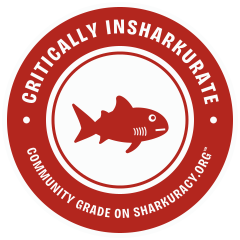
Critically InsharkurateIndex 0 to 12
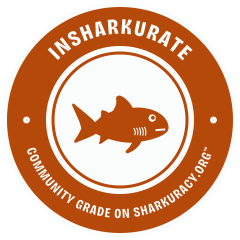
InsharkurateIndex 13 to 37
Partly SharkurateIndex 38 to 62
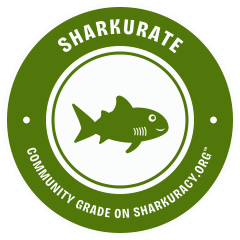
SharkurateIndex 63 to 87
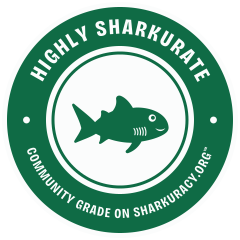
Highly SharkurateIndex 88 to 100
Who the ratings come from
A title can show grades from three sources.
Community grade
Community grade
Ratings from everyone on Sharkuracy, experts included. The community index is the average of each counted rating's index before the cap, capped by the community's average level on each core criterion. It shows, with the number of ratings, from the title's first counted rating. For a TV series whose episodes are listed, it counts the ratings of the whole series and of each episode together, each person counting once; each episode also has its own index. Its stamp has one inner ring.
Expert grade
Expert grade
Ratings from people an admin has verified as shark experts, from research or other work with sharks and rays. The expert index averages the indexes of their counted ratings only, each taken before the cap, and is capped the same way, by the experts' average level on each core criterion. For a TV series whose episodes are listed, it counts experts' ratings of the series and of its episodes together, each expert counting once. It shows beside the community index, never merged with it, from the first counted expert rating. Its stamp has two inner rings, like a seal. Meet them on Our shark experts.
AI-generated grade
AI-generated grade
Until the community index shows, a title may show one AI-generated grade as a placeholder. The AI chooses from the same five levels, or Not applicable, under the same rules. The AI gives one piece of evidence per criterion and may abstain.
Its stamp has a dashed band and a robot shark. Once the title has its first counted community or expert rating, the AI-generated grade disappears from its page.
Language models can label text with more agreement than crowd workers and trained annotators [13], but as judges they also show known biases [14]. So the AI-generated grade is only a placeholder, shown with its evidence, and never counted with people's ratings.
The words we use
Rating
One person's judgement of one title: a level for each criterion, or Not applicable where the rules allow it, under the rules above.
Level
One of the five steps every criterion is judged on, from 1, the worst, to 5, the best.
Points
What each level counts as when a rating's levels are averaged into the index.
Sharkuracy index
The number from 0 to 100 that a rating's levels give, or the AI's levels for the AI index. A title can have a community index and an expert index, from people's ratings, and an AI index until its first counted community or expert rating.
Grade
The name of the band an index falls in, one of the five grades above, printed on top of the stamp. A title can have a community grade, an expert grade and, until its first counted community or expert rating, an AI-generated grade.
Stamp
The image of a grade and its source: the grade on top, the source underneath.
AI-generated grade
A placeholder grade from an AI, shown until a title's first counted community or expert rating, and never counted with people's ratings.
References
We cite only sources we have read.
[1]
Reference 1: Jonsson, A., & Svingby, G. (2007). The use of scoring rubrics: Reliability, validity and educational consequences. Educational Research Review, 2(2), 130–144.https://doi.org/10.1016/j.edurev.2007.05.002
Reference 2: Tarłowski, A., & Rybska, E. (2021). Young children's inductive inferences within animals are affected by whether animals are presented anthropomorphically in films. Frontiers in Psychology, 12, 634809.https://doi.org/10.3389/fpsyg.2021.634809
Reference 3: Whitenack, L. B., Mickley, B. L., Saltzman, J., Kajiura, S. M., Macdonald, C. C., & Shiffman, D. S. (2022). A content analysis of 32 years of Shark Week documentaries. PLOS ONE, 17(11), e0256842.https://doi.org/10.1371/journal.pone.0256842
Reference 4: Le Busque, B., & Litchfield, C. (2022). Sharks on film: An analysis of how shark-human interactions are portrayed in films. Human Dimensions of Wildlife, 27(2), 193–199.https://doi.org/10.1080/10871209.2021.1951399
Reference 5: Muter, B. A., Gore, M. L., Gledhill, K. S., Lamont, C., & Huveneers, C. (2013). Australian and U.S. news media portrayal of sharks and their conservation. Conservation Biology, 27(1), 187–196.https://doi.org/10.1111/j.1523-1739.2012.01952.x
Reference 6: Casola, W. R., Beall, J. M., Peterson, M. N., Larson, L. R., & Price, C. S. (2022). Influence of social media on fear of sharks, perceptions of intentionality associated with shark bites, and shark management preferences. Frontiers in Communication, 7, 1033347.https://doi.org/10.3389/fcomm.2022.1033347
Reference 7: Myrick, J. G., & Evans, S. D. (2014). Do PSAs take a bite out of Shark Week? The effects of juxtaposing environmental messages with violent images of shark attacks. Science Communication, 36(5), 544–569.https://doi.org/10.1177/1075547014547159
Reference 8: Neff, C., & Hueter, R. (2013). Science, policy, and the public discourse of shark "attack": A proposal for reclassifying human-shark interactions. Journal of Environmental Studies and Sciences, 3(1), 65–73.https://doi.org/10.1007/s13412-013-0107-2
Reference 9: Roff, G., Doropoulos, C., Rogers, A., Bozec, Y.-M., Krueck, N. C., Aurellado, E., Priest, M., Birrell, C., & Mumby, P. J. (2016). The ecological role of sharks on coral reefs. Trends in Ecology & Evolution, 31(5), 395–407.https://doi.org/10.1016/j.tree.2016.02.014
Reference 10: Grubbs, R. D., Carlson, J. K., Romine, J. G., Curtis, T. H., McElroy, W. D., McCandless, C. T., Cotton, C. F., & Musick, J. A. (2016). Critical assessment and ramifications of a purported marine trophic cascade. Scientific Reports, 6, 20970.https://doi.org/10.1038/srep20970
Reference 11: Dulvy, N. K., Pacoureau, N., Rigby, C. L., Pollom, R. A., Jabado, R. W., Ebert, D. A., Finucci, B., Pollock, C. M., Cheok, J., Derrick, D. H., Herman, K. B., Sherman, C. S., VanderWright, W. J., Lawson, J. M., Walls, R. H. L., Carlson, J. K., Charvet, P., Bineesh, K. K., Fernando, D., . . . Simpfendorfer, C. A. (2021). Overfishing drives over one-third of all sharks and rays toward a global extinction crisis. Current Biology, 31(21), 4773–4787.e8.https://doi.org/10.1016/j.cub.2021.08.062
Reference 12: Shiffman, D. S., Bittick, S. J., Cashion, M. S., Colla, S. R., Coristine, L. E., Derrick, D. H., Gow, E. A., Macdonald, C. C., More O'Ferrall, M., Orobko, M., Pollom, R. A., Provencher, J., & Dulvy, N. K. (2020). Inaccurate and biased global media coverage underlies public misunderstanding of shark conservation threats and solutions. iScience, 23(6), 101205.https://doi.org/10.1016/j.isci.2020.101205
Reference 13: Gilardi, F., Alizadeh, M., & Kubli, M. (2023). ChatGPT outperforms crowd workers for text-annotation tasks. Proceedings of the National Academy of Sciences, 120(30), e2305016120.https://doi.org/10.1073/pnas.2305016120